

About
Hi, I’m Sumukh.
Psychotherapist and Counsellor. In person in Central London, Croydon, and online across the UK.
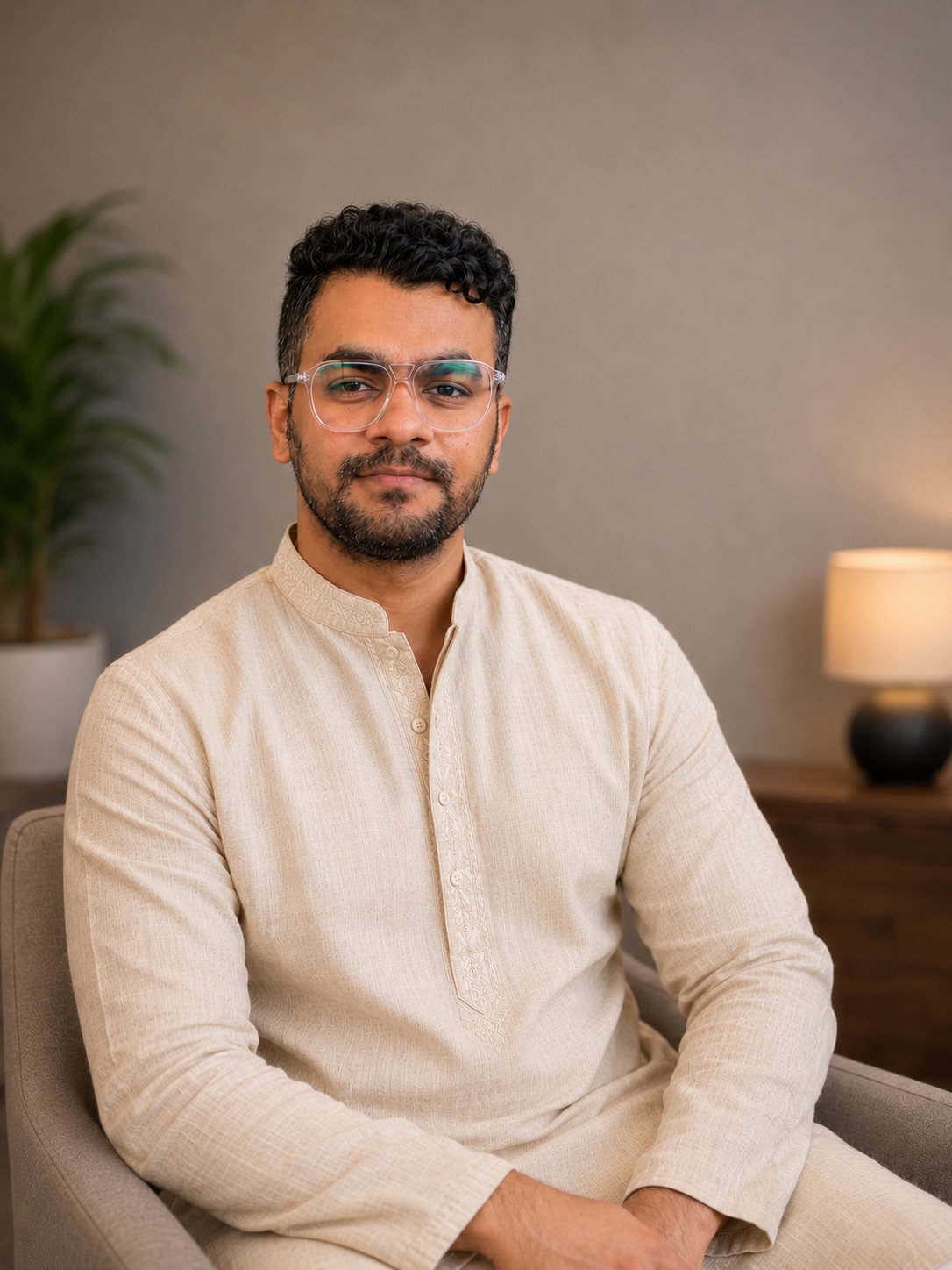
I'm Sumukh Nijhawan, the psychotherapist behind AttuneSpace. I work with men, on the parts of life that tend to stay unspoken. Why closeness can feel harder than it should. The shame that sits quietly underneath. The pull between who you are and who you were raised to be.
Many of the people I see have spent their lives being capable, dependable, and “fine” on the outside, while carrying more than anyone knows. I understand that, personally and through my research, which looks closely at how South Asian men experience closeness, shame and change in their relationships, and why what Western therapy is quick to call “avoidant” is often culture, masculinity and shame, rather than anything broken in you.
My work is not to fix you. It is to give you somewhere to stop performing, be understood, and let something shift at a pace that feels safe. I keep this practice small and personal, so the people I work with have my full attention and the depth the work deserves.
My particular focus is South Asian men, though I work with men of all backgrounds, and with South Asian adults more widely.
Psychotherapist & Counsellor · MNCPS Accred. · MBACP · GMBPsS
Training & research
Where the work is grounded
I am currently completing doctoral training in Counselling Psychology at Metanoia Institute, where my research explores how South Asian men and their families navigate closeness, autonomy and shame across generations. I practise as a trainee counselling psychologist within this programme, alongside my accredited work as a counsellor and psychotherapist.
A particular focus
For South Asian men
Much of my deepest work, and my doctoral research, is with South Asian men.
So much of what we are taught about being a man, and about being a good son, partner or provider, quietly trains us to hold it together, to not need much, and to keep the harder feelings to ourselves. That can look like strength. It can also leave us distant in our closest relationships, carrying a shame we never quite name.
What therapy is quick to call “avoidant” is often not a flaw at all. It is the meeting point of culture, masculinity and shame. You learned to relate this way, for reasons that made sense, and what is learned can be reworked.
“It is a joy to be hidden, but disaster not to be found.”
Donald Winnicott